A useful idea is only the beginning.
THE ECONOMICS OF INNOVATION
Why do useful ideas become ordinary practice in some societies, while remaining isolated achievements in others?

New combinations.
Not just new machines.
ONE BAKERY. FIVE WAYS TO INNOVATE.
The good
A new bread, or better quality.
The method
A different way to make it.
The market
A new neighborhood to serve.
The supply
A new source of flour.
The organization
A different way to organize delivery.
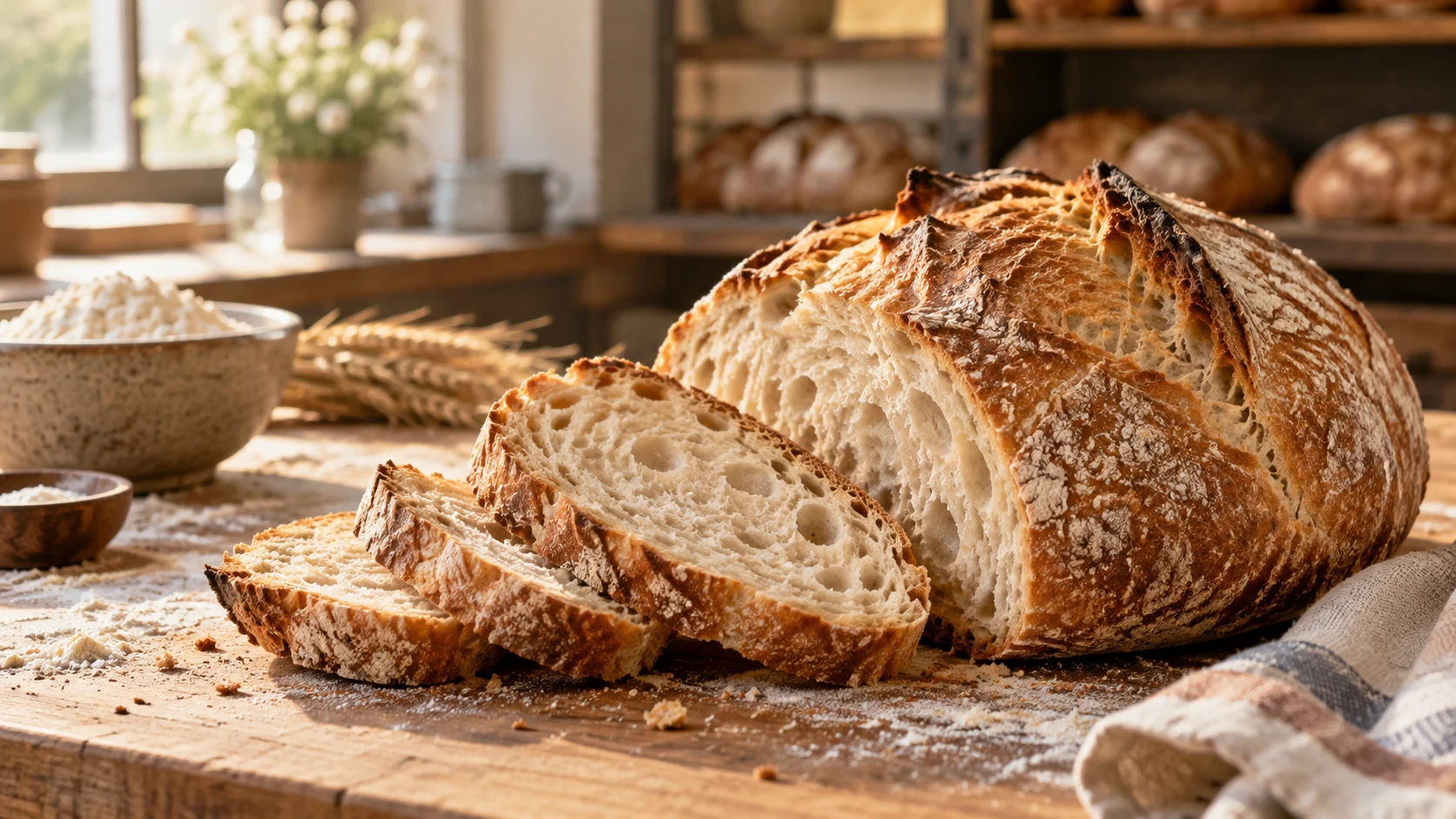
Schumpeter’s five combinations widen the meaning of innovation.
Academic sources: Schumpeter (1934)Broadberry & Zhai (2025 working paper)
Nobody knows enough alone.

The scientist
Knows why it could work.
The technician
Knows how to make it work.
The user
Knows the local problem.
Innovation combines knowledge dispersed across people and places.
The institutional plumbing: legal and property rights · policing · capable taxation and public spending.
Our reading of this imagined community: dispersed knowledge works better when cooperation is dependable.
Academic sources: Hayek (1945) Greif & Laitin (2004)
References and PDF readings
Full citations for the core slides. Earlier drafts and working-paper versions are labelled. Source links support the mechanisms described; they do not establish every policy judgment in this talk. Slide 10: Broadberry and Zhai, printed pp. 28–29. Slide 11: Mokyr (2005), printed pp. 297–298 and 341–342.
Hall & Khan (2003)
Hall, Bronwyn H., and Beethika Khan (2003). Adoption of New Technology. NBER Working Paper 9730.
PDF: author-hosted November 2002 draft. The reference is the 2003 working paper, also published in New Economy Handbook.
Schumpeter (1934)
Schumpeter, Joseph A. (1934). The Theory of Economic Development. Harvard University Press, Chapter II, p. 66.
No open original PDF confirmed. Broadberry and Zhai (2025), pp. 3–4, provide an accessible secondary discussion of the five combinations.
Mokyr (1990)
Mokyr, Joel (1990). The Lever of Riches: Technological Creativity and Economic Progress. Oxford University Press.
Original 1990 book attribution. No suitable open original PDF confirmed. See Mokyr (1998 manuscript) for direct discussion of macroinventions and microinventions.
Mokyr (2005)
Mokyr, Joel (2005). The Intellectual Origins of Modern Economic Growth. Journal of Economic History 65(2): 285–351.
University-hosted paper. Propositional and prescriptive knowledge; not the direct source for the macro/micro distinction.
Hayek (1945)
Hayek, F. A. (1945). The Use of Knowledge in Society. American Economic Review 35(4): 519–530.
University-hosted journal article.
Baumol (1990)
Baumol, William J. (1990). Entrepreneurship: Productive, Unproductive, and Destructive. Journal of Political Economy 98(5, Part 1): 893–921.
Publisher access may require a subscription. No author/repository open PDF confirmed.
Aghion & Howitt (1992)
Aghion, Philippe, and Peter Howitt (1992). A Model of Growth Through Creative Destruction. Econometrica 60(2): 323–351.
University-hosted journal article.
Aghion et al. (2005)
Aghion, Philippe, Nicholas Bloom, Richard Blundell, Rachel Griffith, and Peter Howitt (2005). Competition and Innovation: An Inverted-U Relationship. Quarterly Journal of Economics 120(2): 701–728.
PDF: open 2005 journal article from Harvard DASH.
Broadberry & Zhai (2025 working paper)
Broadberry, Stephen, and Runzhuo Zhai (2025). Innovation and the Great Divergence. CAGE Working Paper 771/2025, September version.
Working-paper version. Compare regions and periods; the paper does not establish a universal Europe–Asia ranking.
Mokyr & Tabellini (2024)
Mokyr, Joel, and Guido Tabellini (2024). Social Organizations and Political Institutions: Why China and Europe Diverged. Economica.
PDF is the 2023 working-paper version, IGIER 697.
Greif & Laitin (2004)
Greif, Avner, and David D. Laitin (2004). A Theory of Endogenous Institutional Change. American Political Science Review 98(4): 633–652.
Author-hosted journal article. Explains change; does not establish that deliberate reform always improves institutions.
Stiglitz (2014 working paper)
Stiglitz, Joseph E. (2014). Intellectual Property Rights, the Pool of Knowledge, and Innovation. NBER Working Paper 20014.
Theoretical working paper. Not an empirically estimated universal optimal-IP curve.
Mazzucato (2011 report)
Mazzucato, Mariana (2011). The Entrepreneurial State. Demos.
Academic-authored policy report. This is the 2011 report, not the later 2013 book.
Rodrik (2004 working paper)
Rodrik, Dani (2004). Industrial Policy for the Twenty-First Century. Harvard Kennedy School Working Paper RWP04-047.
PDF is the September 2004 manuscript; the HKS working-paper record is November 2004. A framework for scrutiny, not a direct rebuttal of Mazzucato.
Brynjolfsson, Rock & Syverson (2021)
Brynjolfsson, Erik, Daniel Rock, and Chad Syverson (2021). The Productivity J-Curve: How Intangibles Complement General Purpose Technologies. American Economic Journal: Macroeconomics 13(1): 333–372.
PDF is NBER Working Paper 25148 (2018, revised 2020), not the 2021 journal version.
Hausmann, Rodrik & Velasco (2005)
Hausmann, Ricardo, Dani Rodrik, and Andrés Velasco (2005). Growth Diagnostics. Working paper, March.
Diagnostic framework. The proposed India application is ours, not a finding about India from this paper. Official Growth Lab PDF, March 2005.
Mokyr (1998 manuscript)
Mokyr, Joel (1998). The Second Industrial Revolution, 1870–1914. August chapter manuscript, printed pp. 1–2.
Author manuscript; companion to the original 1990 book attribution.
Personal reflections
These are Ashish’s notes, offered alongside the academic references:
Easterly & Fischer (1995)
Easterly, William, and Stanley Fischer (1995). The Soviet Economic Decline. World Bank Economic Review 9(3): 341–371.
Official journal PDF. Examines Soviet growth, capital accumulation and diminishing returns. The incentives-and-diffusion lens is a discussion hypothesis, not the paper’s complete explanation.
Buchan (2023)
Buchan, James (2023). John Law and Genoa. In Andrea Zanini (ed.), Per Giuseppe Felloni, ricercatore e maestro. Memorie e scritti di storia economica. Quaderni della Società Ligure di Storia Patria 13, pp. 191–204. DOI: 10.5281/zenodo.7530126.
Scholarly chapter, pp. 194–199 for proposals and outcomes. Possible remembered book: Buchan, John Law: A Scottish Adventurer of the Eighteenth Century (2018); identification is tentative. Book details ↗
de la Croix, Doepke & Mokyr (2018)
de la Croix, David, Matthias Doepke, and Joel Mokyr (2018). Clans, Guilds, and Markets: Apprenticeship Institutions and Growth in the Preindustrial Economy. Quarterly Journal of Economics 133(1): 1–70.
Author-hosted journal article. See pp. 6–7, 14–18 and 63 on learning beyond kin, apprenticeship flexibility and watchmaking. The modern university comparison is a discussion judgment.
Kwa et al. (2025; updated 2026)
Kwa, Thomas, Ben West, et al. (2025). Measuring AI Ability to Complete Long Software Tasks. NeurIPS 2025; arXiv:2503.14499v4, revised 10 July 2026.
Academic paper; linked version is the updated author preprint. Selected software tasks, not a universal measure of capability or organisational adoption.
Tabarrok (2011) · further reading
Tabarrok, Alex (2011). Launching the Innovation Renaissance: A New Path to Bring Smart Ideas to Market Fast. TED Books.
Author-hosted book. Complements the Stiglitz academic anchor on slide 13. The quoted sentence follows a comparison of innovation-support institutions.
Revision record
3 October 2026 — slides 1–20: removed all speaking notes and cover duration; reduced navigation; added rounded image corners and bread imagery; centred slides 4, 5, 7, 9 and the conclusion. Added verified quotations, historical why/how examples, institutional context, John Law’s banking episode, Cold War discussion, AI pace and domain examples, a concrete hypothetical permit-office trial, and a new apprenticeship slide. Added academic references and Ashish’s public state-innovation reflection. Rebalanced teaching time to retain the 75-minute session.
3 October 2026 — visual revision after Ashish’s review: rebuilt the 19 slides with point-making titles, varied compositions, locally hosted Fraunces and Source Serif typography, and two labelled generated conceptual illustrations. Kept all speaking notes, timing, academic references, and evidence boundaries. The design review tightened the diffusion headline to avoid treating widespread adoption as a condition for any economic effect.
3 October 2026 — prepared the October version from the February presentation and the subsequent discussion. Added the rewards-to-effort lens, institutional revision, and an activity-specific approach to AI adoption. Kept the role of the state open. Added academic sources, version labels, examples, and evidence boundaries to every substantive slide.
3 October 2026 — redesigned the October deck after content approval: message-led titles, varied mechanism diagrams, local presentation fonts, and labelled conceptual imagery. Preserved source boundaries, speaking notes, and timing.
Approved for publication by Ashish on 3 October 2026.